
Inspired EMDR Basic Training prioritizes foundational learning, offering a deliberate pace and tailored attention, making EMDR comprehensive and deeply understood.
With it’s low trainer-to-participant ratio, a moderate training pace and ample dedicated practice time, you’ll build a strong clinical foundation under the close guidance of Cheryl Kenn, an experienced EMDRIA Approved trainer. As an added benefit, 10 hours of consultation are included in the training at no extra cost. Special rates are offered for non-profit & community mental health clinicians, students and groups. Inspired EMDR Basic Training is a comprehensive, interactive, and structured course that will allow you to become familiarized with the necessary skills, procedures and principles of EMDR Therapy so that you may confidently and successfully begin applying it in your practice.
Upon registering, you will gain access to your learning management system account which is a portal to the essential resources for your EMDR journey.
UPCOMING EMDR BASIC TRAININGS:
In-Person East Greenwich, RI, Smith Hall, Westminster Unitarian Church 9am-5:30pm
- Part 1: Day 1 & 2 Sep 21-22 (M-T)
- Part 2: Day 3 & 4 Oct 23-24 (F-S)
- Part 3: Day 5 & 6 Nov 2-3 (M-T)
- Part 4: Day 7 & 8 Nov 18-19 (W-Th) *on Zoom
Virtual 9am-5pm ET
- Part 1: Day 1 & 2 Sep 12-14 (Sat-Sun)
- Part 2: Day 3 & 4 Sep 26-27 (Sat-Sun)
- Part 3: Day 5 & 6 Oct 17-18 (Sat-Sun)
- Part 4: Day 7 & 8 Nov 7-8 (Sat-Sun)
Virtual 9am-5:30pm* Join the waitlist. Registration will open soon.
- Part 1: Day 1 & 2 Jan 14-15 2027 (Th-F)
- Part 2: Day 3 & 4 Jan 25-26 (M-T)
- Part 3: Day 5 & 6 Feb 11-12 (Th-F)
- Part 4: Day 7 & 8 Mar 1-2 (M-T)

Training Overview
The Inspired EMDR Basic Training in grounded in fidelity to Dr. Francine Shapiro’s foundational model while promoting proficiency… skillfully, thoroughly and effectively.
EMDR Therapy is a standardized treatment that is used world-wide. It is an evidence-based psychotherapy not only for the treatment of PTSD and trauma-related problems, but also for a wide range of mental health issues, such as depression, anxiety, phobias, low self-esteem, traumatic grief, addictions and compulsions, somatic responses related to illness and injury, and relationship difficulties.
The training is based on the foundational teachings of the originator of EMDR therapy, Francine Shapiro, PhD. Participants will understand and practice core EMDR Therapy skills and procedures and will have the ability to expand these skills for use with a wide range of clinical presentations and situations.
What distinguishes this training from others?
A Comprehensive, Personalized Approach:
Inspired EMDR’s training is thoughtfully designed to be personalized, comprehensive, and highly practical, so you can begin applying your new skills in your clinical work with confidence right away, You’ll benefit from individualized instruction and a low trainer-to-trainee ratio. With more time and attention tailored to you, you will more easily gain early confidence in practice.
Directly Trained in Francine Shapiro’s Model:
This approach is guided by Cheryl Kenn, who was trained as a trainer in Francine Shapiro’s original model by Deany Laliotis, the Director of Training at the EMDR Institute – appointed by Dr. Shapiro. As a trainer, Cheryl remains deeply committed to honoring Dr. Shapiro’s original vision.
Continuity, Integration of Learning and Practice:
Cheryl carefully monitors all aspects of the training, providing continuous support and seamless integration across instruction, consultation, and practice. This personalized approach, with close supervision, supports how you apply EMDR in your real-life clinical work. The unique, seamless integration of learning, practice, and real-client application, supervised by Cheryl, helps you build a strong, confident foundation in EMDR therapy.
Thoughtful Pacing for Deep Learning and Minimal Disruption:
Unlike standard training formats which take place for 3 or more consecutive days, this training consists 2-day sessions spread across for parts in the program. This paced structure aligns with established learning theory, which emphasizes that combining a layered curriculum with spaced repetition is the most effective strategy for mastering complex material. With minimal disruption to your schedule, you can gradually introduce EMDR into your practice at a comfortable rhythm, building your skills cumulatively.
More Time to Practice:
Throughout the training, you will participate in 24 hands-on practice sessions -more than in standard formats- rotating through the roles of therapist, client, and observer. The extended schedule also gives you more time to assimilate new concepts in-between the four training Parts. This combination of ample in-training practice and real-world application helps you build stronger skills, smoother confidence, and better long-term mastery of EMDR therapy.
Rich Learning Resources:
You will benefit from a wide range of high-quality learning materials designed to support your understanding and mastery of EMDR therapy. The training features clear and engaging video demonstrations, live demonstrations, and well-organized supplemental resources. Key concepts are presented in an easy-to-understand manner, with purposeful focus on the core EMDR principles throughout the program to reinforce learning, ensuring you gain both clarity and confidence in applying EMDR techniques.
Fully inclusive. All costs covered:
All consultation is embedded in the training days and is covered in the tuition. You will not need to arrange or pay for outside consultation, removing common barriers and allowing you to focus fully on developing your skills.

Training Content
- 8 days of training in four 2-day parts across 3 months
- 51.5 total hours. This course exceeds the approved standards of EMDRIA (EMDR International Association) .
- 20 hrs. of didactic instruction
- 21.5 hrs. of small-group supervised practice
- 10 hours of required consultation embedded in the training and included in the tuition.
- Extensive videos of EMDR sessions, additional video lectures, demonstrations,
- Participation in 24 sessions of live practice sessions (more than standard EMDR trainings) build a strong foundation in acquiring skill and experience.
- Scripts, handouts and all materials for the training, will be made available to you through an LMS.
- 41.5 CEs are awarded
- The In-Person training is hybrid. Days 6, 7, 8 OR Days 7, 8 are on Zoom to address how to apply EMDR therapy through telehealth.

Overview of Training Outcomes
The training outcomes are designed with thoughtful care with the new training participant in mind… it’s centered on providing support and a solid grasp of the EMDR model.
- Gain a solid foundation in EMDR as a complete psychotherapy approach through didactic teaching and hands-on practice.
- Learn the eight phases of EMDR and apply them with confidence and procedural integrity.
- Develop strong case conceptualization skills grounded in the Adaptive Information Processing (AIP) model.
- Receive personalized guidance to effectively integrate EMDR into your clinical practice alongside psychodynamic, cognitive-behavioral, and systemic approaches.
- Confidently apply EMDR and the AIP model to a wide range of clinical issues, including acute trauma, recent traumatic events, PTSD, complex trauma, addictions, phobias, somatic symptoms, traumatic grief, and clients such as first responders and those exposed to combat trauma.
- Learn to screen for and recognize dissociation and become aware how to identify if and when modifications to the EMDR procedures may be necessary during assessment, preparation, and reprocessing phases.
- Strengthen clinical decision-making, using clear markers within culturally responsive frameworks attentive to race, culture, gender identity, and systemic factors.

Once you complete the training you will…
- Receive an EMDR Basic Training completion certificate
- Be able to join EMDRIA at the Full Member level, assuming you meet the specified requirements for that level of membership
- Be able to start working on completing the requirements for EMDR Certification
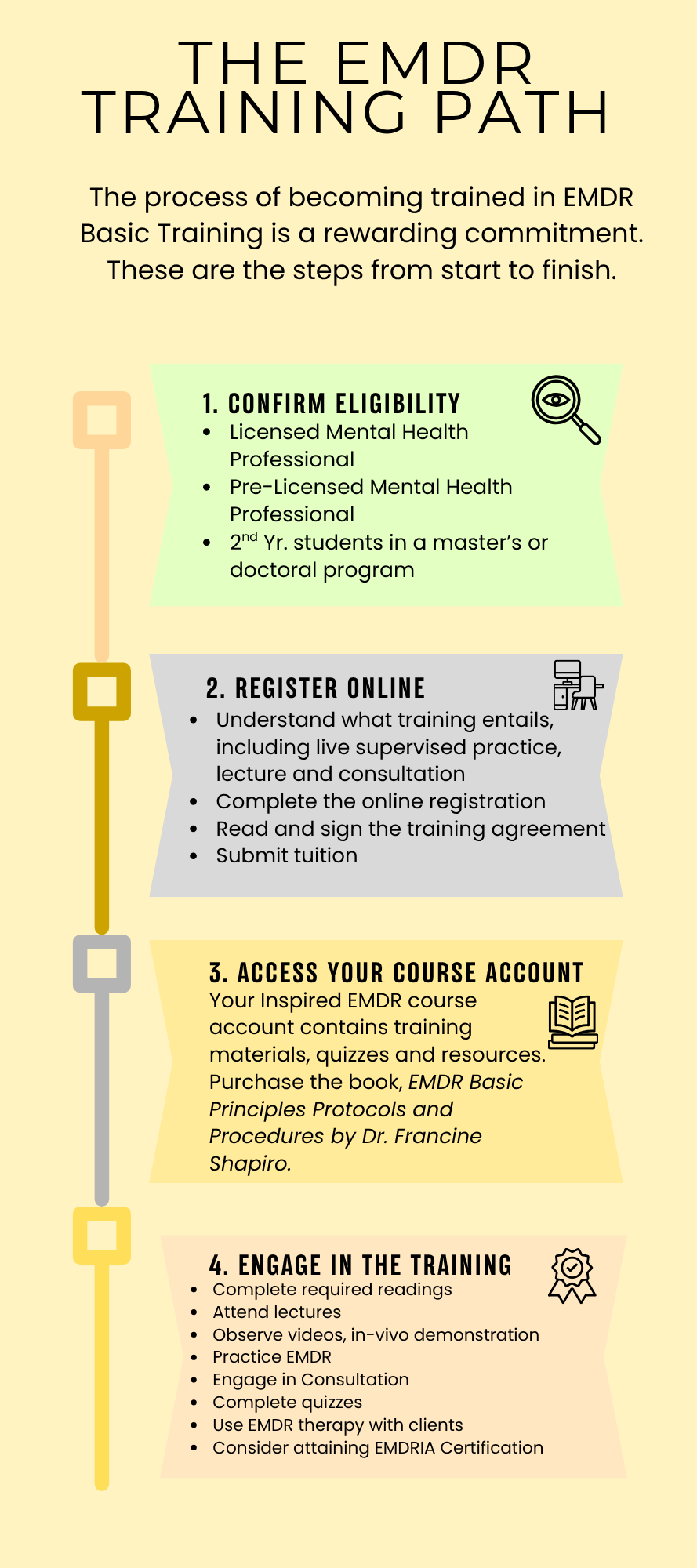

Eligibility and Completion Requirements
Eligibility Requirements: EMDRIA Guidelines determine who can attend.
Mental health professional licensed for independent practice, or who are on a licensing track under the supervision of a licensed supervisor.
- Social Workers
- Psychologists
- Mental Health Counselors
- Marriage and Family Therapists
- Psychiatrists
- Psychiatric APRNs
- Pre-Licensed Clinicians with Masters Degrees pursuing licensure with their state board, under the guidance of a clinical supervisor, who will submit a letter of status confirmation.
- Interns/Graduate students who have completed their core coursework (2nd year students) and are in a practice setting under the guidance of a clinical supervisor, who will submit a letter of status confirmation.
- Individuals who only hold a chemical dependency or substance abuse license are not eligible.
- Clinicians who have already taken an EMDR training are eligible to take the training at the student rate.
- Completion Requirements: Completing all days in the 8 day training, comprised of lecture, practice and consultation.
- Reading EMDR: Basic Principles, Protocols and Procedures (Shapiro 2017) and additional readings provided.
- Completion of an open-book learning assessment
- Attendance at all sessions. Partial credit is not given.
- Graduate Students Supervisor Letter Requirements • Enrolled in a master’s or doctoral mental health program.
• On an independent licensure track.
• In the clinical practicum or internship phase.
• Actively seeing clients under supervision.
• Letter must include supervisor’s degree, license type, license number, signature, and be on official agency letterhead. - Pre-Licensed Clinicians (Associates, Interns, Residents) Supervisor Letter Requirements • Post-graduate status actively pursuing full, independent licensure.
• Currently working under direct clinical supervision.
• Letter must include supervisor’s degree, license type, license number, signature, and be on official agency letterhead.


Continuing Edcuation Credits
This program has been approved for Continuing Education Credit Hours by NASW-CT and meets the continuing education criteria for Social Work Licensure renewal. 41.5 continuing education credits (CEC) approved by the National Association of Social Workers (NASW-CT). NASW-CT approvals are valid in CT, MA, RI, and VT. NASW-CT CEC approvals apply to the following license types: Licensed Clinical Social Worker (LCSW), Licensed Master of Social Work (LMSW), Licensed Marriage & Family Therapist (LMFT), Licensed Professional Counselor (LPC), and Licensed Clinical Psychologist (PsyD). The course does not offer Continuing Medical Education (CME) credits. or NBCC credit.
It is the sole responsibility of the training participant to verify with their own state licensing or regulatory board whether these continuing education credits will be accepted for their professional license.
Inspired EMDR Basic Training is an immersive, cutting-edge learning journey that empowers you with the solid expertise and skills to make nuanced clinical judgments essential for effectively delivering EMDR therapy to your clients.
Learn more about the training contents, structure and practice expectations…
Course Objectives
Part 1: Day 1 & 2
- Review the history of the origin and development of EMDR and its supporting research
- Acquire skill in identifying the clinical determinants of Traumatization and PTSD
- Become versed in distinguishing the neurobiological effects of trauma on the brain
- Describe the Adaptive Information Processing theory of EMDR
- Acquire skill in how to take a trauma history and develop an EMDR treatment plan
- Identify how to conceptualize a case across the 8-phases and 3 prongs.
- Determine client readiness for EMDR
- Describe presentations and common symptoms of complex trauma.
- Discern when and how to apply safeguards during History Taking and Preparation
- Develop and practice Resourcing and the Safe/Calm Place and other stabilization skills
Part 2: Day 3 & 4
- Gain skill in accessing components of the target memory
- Establish an understanding of negative and positive Cognitions
- Identify 8 phases of the EMDR Standard Protocol
- Be able to identify and address blocking beliefs and feeder memories.
- Acquire skill in utilizing Phase 8: Re-evaluation.
- Identify how to apply bilateral stimulation using eye movements and tapping.
- Identify procedural steps for closing down an incomplete session.
- Identify how to resume reprocessing on an incomplete target memory.
- Practice reprocessing procedures for a target memory
- Utilize on-going case consultation for all aspects of EMDR therapy.
Part 3: Day 5 & 6
- Describe the 3 information categories of relevant clinical themes related to client beliefs
- Demonstrate proficiency in utilizing strategies for modulating over-activation & for over-activation during reprocessing.
- Review determinants of the application of EMD and its use.
- Describe the qualities of the cognitive interweave
- Acquire skill in applying additional techniques to handle looping, resistance and other problems
- Acquire skill in applying the Recent Event Protocol in EMDR therapy.
- Gain knowledge in the treatment of phobias and anxiety.
- Describe addressing treatment of Grief and Mourning.
- Identify how to apply treatment for psychological responses to pain, illness and injury.
- Practice reprocessing procedures for a target memory
- Utilize on-going case consultation for all aspects of EMDR therapy.
Part 4: Day 7 & 8
- Acquire skill in conceptualizing the 3 Stages of Trauma Treatment.
- Establish a knowledge base of the special clinical issues that present with adult survivors of childhood abuse and neglect.
- Distinguish the clinical presentations requiring additional specialized training and how to access further training.
- Review additional modifications to the standard protocol for clients presenting with complex trauma.
- Acquire knowledge about specific interventions to use with EMDR to establish and maintain client safety and stability with clients presenting with dissociative phenomena.
- Identify how and when to apply the CIPOS protocol.
- Practice reprocessing procedures for a target memory utilizing the present trigger, future template and EMD.
- Utilize on-going case consultation for all aspects of EMDR therapy.
Training Structure
The Basic Training is organized into four parts, of two consecutive days. 8 days total spread over three months.
- The training is typically from 9am-530pm
- Breaks vary throughout the lecture and practice.
- Lunch (on your own) is approximately 1 hour between 1:00-2:00
Each training day consists of…
- Lecture
- Consultation (in Parts 2-4)
- Practice
Each morning consists of a lecture portion with discussion, video and live demonstrations of EMDR principles, concepts and procedures. In the afternoons, training participants practice EMDR methods as therapist, client and observer on self-selected issues to experience the application of EMDR. Case consultation on Days 3-8, is comprised of group discussion led by an Approved Consultant of clinical applications of EMDR therapy with clients.
This integrative module provides a comprehensive, evidence-based framework for understanding foundational EMDR dynamics. Participants will engage in a nuanced exploration of core theories, integrating contemporary research with established clinical models. Through a collaborative learning model, participants will master sophisticated techniques and build robust, personalized intervention strategies. I am committed to providing you with a solid foundation in the core elements of this powerful methodology.
Preparedness for Experiential Practice
The training integrates a hands-on practicum component throughout the curriculum consisting of a substantial amount of practice in experiential EMDR sessions. A core requirement in supervised practice involves assuming the roles of the therapist, client and observer, ensuring comprehensive skill development in all aspects of the process. Participants will be asked to apply the EMDR procedures on self-selected disturbing issues. Emotional material may arise during and after the practice. Therefore, prior to registering, it is important to consider that it is essential that the training participant possesses adequate capacity for emotional regulation available throughout the training as well as access to supports as needed.

Testimonials

Beyond the content itself, Cheryl brought warmth, authenticity, and genuine care to the experience. She fostered thoughtful discussion, encouraged curiosity, and modeled the kind of attunement that is so essential in trauma work. I would highly recommend her training to any clinician looking to deepen their skills and confidence in EMDR practice. “
Rebekah Rosler, LICENSED CLINICAL SOCIAL WORKER
“Cheryl is an excellent trainer. The training was incredibly well organized, thoughtfully paced, and easy to follow from start to finish. She created a supportive learning environment, gave insightful and constructive feedback, and clearly has deep knowledge and experience with EMDR. I left feeling much more confident and well prepared to integrate what I learned into my work.”
Julie Ingenohl, LICENSED CLINICAL SOCIAL WORKER


“I highly recommend Cheryl’s EMDR training for clinicians who want to learn how to practice EMDR correctly and confidently. Cheryl has a calm, insightful, and grounded teaching style that creates a supportive learning environment. Because of her training, I feel confident in my EMDR practice. Her ability to connect the material to real clinical work made the training both meaningful and practical.”
Danielle Maryott, LICENSED CLINICAL SOCIAL WORKER
“I am beyond grateful for the training I received through Inspired EMDR with Cheryl Kenn, LCSW. With this basic training, I have been successful in helping many clients heal from past trauma that otherwise would not have been possible in such a short amount of time.”
Sommer Cook, LICENSED CLINICAL SOCIAL WORKER


“Small cohorts, extended opportunities for practice and reflection within and in-between workshop sessions, and Cheryl’s expertise in sharing the EMDR model — priceless! This is transformational training at its best.”
Traci Hodes, PSYCHOLOGIST
“This training greatly exceeded my expectations, and I left the training feeling prepared to start practicing EMDR right away! Cheryl thoroughly prepared our group with thoughtfulness and enthusiasm”
Samantha, Rose LICENSED INDEPENDENT SOCIAL WORKER


“The training I attended for EMDR was exceptional. Cheryl’s knowledge, compassion and authenticity was thread throughout the training. The material presented was engaging, clear and informative. I felt supported throughout the training and my confidence grew after each session. EMDR is a valuable addition to my clinical practice. I highly recommend this training.”
Heidi Hughart, LICENSED PROFESSIONAL COUNSELOR
FAQs
What is the attendance policy?
Do I have to work on my own personal material?
A substantial portion of the training involves experiential learning – applying and having firsthand experience with the EMDR procedures in pairs as therapist & client. The trainer and staff strive to create an atmosphere of learning, safety, professionalism and confidentiality, making the practice a place of discovery and enrichment. The participant is asked to engage in real EMDR processes using self-selected issues, that are appropriate for a professional training setting. Some guidelines about selecting issues include recommending having the “client” select issues that are under a subjective units of distress of 5, in terms of disturbance. In addition, it is recommended that the client choose issues that lie outside of the area of family-of-origin issues. During the practice, emotional material may arise during and after the practice. Therefore, prior to registering, it is important to consider that it is essential that the training participant possesses adequate capacity for emotional regulation available throughout the training as well as access to supports as needed.
Thousands of EMDR clinicians have found the practicum to be an essential and illuminating part of truly understanding and witnessing EMDR’s transformative power. Please inquire if you have any questions.
What is an EMDRIA Approved Training?
An EMDRIA Approved EMDR Basic Training is a valuable distinction that affirms that your foundation in Basic Training meets the rigorous international standards for curriculum, instruction and consultation. Completing an EMDRIA Approved program is a strict prerequisite if you plan to acquire advanced credentials like formal EMDR Certification designation or become a Consultant able to grant EMDRIA credits for consultation to consultees.
- Prerequisite for Certification: If you want to become a fully Certified EMDR Therapist, you must start with an EMDRIA Approved program; non-approved courses will not count toward these future career milestones.
- Mandatory Consultation: Approved programs require 10 hours of supervised case consultation, ensuring you learn to apply the EMDR standard protocol as well as it’s modifications for special populations and situations, safely and ethically with real clients.
- Professional Credibility: An EMDRIA Approved curriculum grants clinical competency that is recognized by insurance panels, employers, and the broader trauma-treatment community.
- Quality Assurance: You receive a complete foundational framework grounded in the Adaptive Information Processing (AIP) model, preventing clinical complications down the road. Non-standardized trainings may lack in many areas, most importantly, in fidelity to the core tenants of EMDR.
Are there payment plans or discounts?
Yes! Tuition is offered on a two or three payment installment plan. The first payment may be made to secure your place, while the remainder is due by 14 days before the training start date. Please email Cheryl to inquire about the 3 payment installment plan.
Discounts are available for early registration (-$50), groups of 3 registering together (-$50) and lower rates for full-time community mental health workers and students.
For agencies wishing to send staff, discounts are available at the student rate. Please inquire.
Scholarships are also available. Please inquire for more information.
What do I have to do to prepare for the training?
Please purchase the book (not included in tuition) EMDR Basic Principles, Protocols and Procedures, by Dr. Francine Shapiro (2017). This book will need to be read in its entirety, and is the foundation for the concepts and principles taught in the training.
Upon registering, signing the Participant Agreement and submitting tuition, you will be given access to your Inspired EMDR Course account, a library of scripts, videos, slides, handouts and resources – two courses that you will have access to for one year. You will complete the readings, view the videos and learning assessments and prepare cases for discussion during consultation.
PRINTING: For the virtual portions of the training, you will print the scripts for the practice. In-person training participants do not have to print anything for the practice days.
Can student interns or pre-licensed clinicians attend?
Yes! Pre-licensed clinicians and 2nd Year Graduate students who have completed their core coursework can apply. Confirmation from a licensed supervisor acknowledging that you are currently practicing under the supervision of a licensed professional will be required.
Please wait to register until your supervisor letter is ready. To complete your registration successfully, both the online registration and the letter must be submitted together.
Required Letter Verifications & Details | |
Graduate Students | • Enrolled in a master’s or doctoral mental health program. • On an independent licensure track. • In the clinical practicum or internship phase. • Actively seeing clients under supervision. • Letter must include supervisor’s degree, license type, license number, signature, and be on official agency letterhead. |
Pre-Licensed Clinicians (Associates, Interns, Residents) | • Post-graduate status actively pursuing full, independent licensure. • Currently working under direct clinical supervision. • Letter must include supervisor’s degree, license type, license number, signature, and be on official agency letterhead. |
Is consultation included in the tuition?
- The 10 required consultation hours are included in the tuition.
- Consultation is embedded within the training schedule, occurring on Days 3–8 with your original cohort.
- Practical forms are provided to assist with documenting and organizing your clinical work.
This structure is designed to ensure a seamless and comprehensive training experience with no hidden fees.
In the in-person training, will I learn how to use EMDR virtually?
Yes! The in-person training takes place on Zoom on days 6, 7, 8 or 7&8 depending on the venue. The incorporation of virtual training will give you the practice skills to apply EMDR virtually as well.
Will I be Certified in EMDR after taking this training?
Basic Training vs. Certification are separate designations. Completing an EMDRIA-approved Basic Training qualifies you as a clinician “trained in EMDR Therapy”. EMDR Certified Therapist is an advanced designation that demonstrates the clinician has higher competency. Certification requirements include:
- Full independent licensure in your state/province
- At least 2 years of clinical experience
- Completion of an EMDRIA-approved Basic Training (20 hours didactic + 20 hours supervised practice + 10 hours consultation)
- 50 EMDR sessions with at least 25 different clients
- 20 hours of consultation with an EMDRIA-Approved Consultant (at least 10 hours individual)
- 12 hours of EMDRIA-approved continuing education
- Letters of recommendation from two EMDRIA-Approved Consultants
Note: Newly trained clinicians qualify for discounted EMDRIA membership (within one year of Basic Training). Interns may join as associates and upgrade to full membership after licensure. Full details: www.emdria.org
What is the cancellation policy?
Tuition is refundable up to 10 days before the training start date. Registration is non-refundable within 10 days of the start date. Participants wishing to withdraw within 10 days may request a transfer to the next scheduled training, subject to availability. Refunds will not be issued to participants who are unable to complete the training within one (1) year from the original start date.
Can I attend if I have already been trained in EMDR?
Can I arrange for a private training for our staff?
Yes! Cheryl if available to offer group trainings for agencies, organizations and small practices interested in training staff in EMDR and trauma therapy. Virtual or on-site in-person trainings are available. Minimum number of participants is 8 persons. Please inquire.
“I look forward to supporting you as you embark on the transformational journey of training in EMDR. It’s an honor to share this powerful therapeutic approach with you. It is my intention that you will discover that EMDR will inspire and empower you to deliver profound and lasting and healing for your clients.”
– Cheryl
“The goal of EMDR Treatment is to rapidly metabolize the dysfunctional residue from the past and transform it into something useful.”
– Dr. Francine Shapiro

Training Inquiries